
Axis Mundi
On place-based centers

Autumn greetings, friends! I’m writing to you from the airport on my way home from the Festival of Faiths in Louisville, Kentucky, on the theme of Sacred Belonging. It was a beautiful gathering of diverse religious and spiritual practitioners and seekers, and I left feeling full of what is possible when we come together on common ground.
During the panel that I was on, entitled “Birthing Belonging”—alongside Paul Brandeis Raushenbush, Joi McAtee, Gerardo Abboud, Bishop Evilio Menjivar -Ayala, and the musical talents of Ben Sollee who played his cello to a recording of a dawn chorus of birds—I spoke about the chapter in my book entitled “Axis Mundi” and the importance of sacred centers for bringing us into a deeper sense of our belonging within an interconnected confluence of beings.
So imagined my surprise and delight when I later opened my email to see that Richard Rohr had featured an excerpt from the very same chapter in my book, that very same day!
And what an honor, on any day, to be included in one of the wonderful Richard Rohr’s Daily Meditations. A warm welcome to those of you who have arrived here since then!
I wanted to share here a longer excerpt of the chapter, “Axis Mundi” from Mother, Creature, Kin.
And I want to invite you to share your own axis mundi.
Where are your sacred places? What are the sites / encounters / experiences that center you and orient you to the world? Where are the poles around which you turn?
AXIS MUNDI
My first fragment of memory is of my mother. We are standing together in golden, waving grass. There is the sense that the sun is setting behind us because what I see in the memory is not our physical bodies but our shadows, cast before us, wavering as the grass bends and circles in the wind. My mother and I are holding hands, and in our silhouettes there is no distinction between where she ends and I begin. And the grass of the rolling plains grows and reaches through our conjoined image.
When I was one and two years old, we lived on a Nature Conservancy preserve that spanned more than fifty thousand acres along the Niobrara River in north central Nebraska—a landscape of Sandhills prairie, bur oaks, and bison. Later we would move to Omaha, and shortly after to Oklahoma. For a long time, I wasn’t sure that this grass-memory with my mother was of a real moment. Perhaps it was an impression, a vague recall of a distant place and time that my mind gave shape to, filling in the blanks.
But my mom confirmed that this did happen: she remembers it, too.
This memory has been with me for a very long time. It has had different things to say to me at different points in my life. We all have these, I think: encounters with the living world that not only stay with us but take on more meaning and power over time.
Perhaps it’s an early memory that stays firmly planted, or an unexpected swell of awe, or a fleeting but deeply felt connection. These experiences can become fixed points, poles around which parts of us will always turn, orbiting again and again around the truth that lies at their center.
* * *
One of my favorite questions to ask people is whether they experience the sacred in the living world. Everyone I have ever put this question to has, near-immediately, answered “yes,” even if they would not call themselves spiritual or ever employ the word sacred. The affirmative answer to that question is also always paired with a specific place or experience. I’ve heard countless stories of what I’ve come to think of as axis mundi experiences: encounters that have pulled someone into a deep experience of felt belonging upon the tiny bit of Earth that they find themselves upon.
It’s often very simple: a passing deer or a bathing bird that somehow opens a window into their sensory being, and, from there, the relationship flows freely, not between I and it, but I and thou.
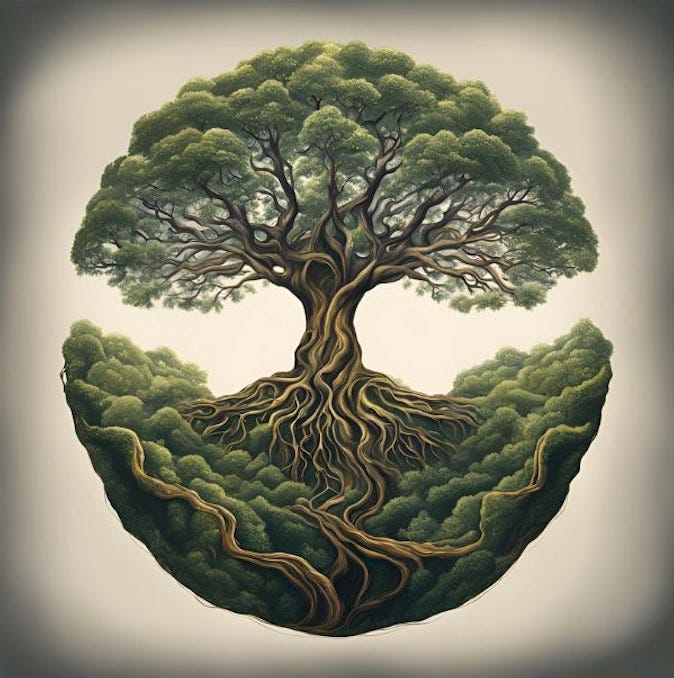
Within the study of religion, an axis mundi is a sacred pole, literal or figurative, which is fixed in a particular place, connecting Earth to the realms of heaven, underworld, and divine. These holiest places are often mountains, as in the case of Mauna Kea on Hawai‘i’s Big Island, known by the Indigenous Kanaka Maoli to be the umbilical cord—the place from which the world emerged. Mount Meru in Hindu mythology is the home of the gods and the center of the universe. An axis mundi may also be a cosmic tree, as in Norse mythology, or a temple or a shrine. In Islam, the Ka’aba in Mecca, which pilgrims circumambulate seven times, contains within it the stone given to Adam upon his expulsion from paradise, that his sins might be forgiven. The cosmic world turns around these poles, providing a mythic context for understanding one’s place in the universe.
I’ve come to think of axis mundi in two ways: There are capital-A, capital-M Axes Mundi: those most sacred of places for cultures or religious communities—those world-beginning places whose mythological histories weave the people into the past, present, and future of particular landscapes. And then there are small-a, small-m axes mundi: those small, daily irruptions of majesty, those any-place-based encounters with the sacred.
I define “sacred” as that which pulls us beyond the bounds of our individual selves, envelops us within mystery, and gives us a glimpse into the vast, entwined, eternal network of living beings that we are in relationship with. A simpler way of saying it: the moments when we are most fully human via our awareness that we are fully entangled, down to our nuclei and electrons, in the Earth and the cosmos. Such an orientation does not require a belief in God or gods. The living world can illuminate this understanding in the forms of awe and wonder, as well as in the forms of grief and loss.
And such illuminations can arise spontaneously into our consciousnesses, precisely because this sacred truth is always present everywhere upon the Earth, whether or not we are aware of it. Those small-a axes mundi, then, arrive as discrete moments in particular places. They are the moments when that sacred reality comes into focus, inviting us to orient ourselves, even if briefly, to the particular, small bit of the cosmos where we have placed our feet. Perhaps this has happened for you upon reaching the summit of a mountain, or while sitting beneath the boughs of an old growth tree, or simply while hearing the voice of a bird you recognize from your childhood home.
Which is to say: whatever we believe (or don’t) about God and gods, about holy texts and pilgrimages, all of us hold within ourselves the potential to be pinned in place by a sacred pole. And in this time when there is so much disconnect from the living world, so much separation, in this time of razed forests, deserted pockets of warmed oceans, and the echoes of extinct species, orienting ourselves around these fixed points becomes more crucial than ever.
We are a species in need of centers. Place-based centers. Particular place-based centers, around which we can build our orientation to the world. Places that ask for our attention and care as sensory beings. Small-a axes mundi that guide us in moving through this uncertain time.
“There are no privileged locations,” writes Scott Russell Sanders. “If you stay put, your place may become a holy center, not because it gives you special access to the divine, but because in your stillness you hear what might be heard anywhere. All there is to see can be seen from anywhere in the universe, if you know how to look; and the influence of the entire universe converges on every spot.”
I have come, then, to see this memory of my mother and me in the prairie grass as one such convergence, an enduring manifestation of the sacred. A pole that has, for reasons I still don’t fully understand, pinned part of me forever in that prairie grass. It is one way of organizing my relationship to sacred place.
Since my own daughter’s arrival into the world, this memory has returned again to ask me a question. What is it to be a mother in a time of ecological collapse?
Please share your own axes mundi below!
Chelsea, you helped me remember an experience I had with a mystical tree. It appeared in a dream. When I woke up, I didn't remember all the dream details, but the image of this massive leafy tree remained clear. This happened right before I made my first trip across the country to the East Coast. I was heading to North Carolina to research some family history.
I'd forgotten all about the dream tree until it suddenly appeared before me, rising like a sheltering grandmotherly spirit behind the slave quarters of a former plantation. The leaves of this towering Black walnut glowed in the sunlight. I recognized the quality of the light first, then I noticed the graceful arches of the dark branches which created a canopy big enough for a hundred people to gather under. Where slavery had once defined this place, now the presence of this tree defined it. I felt its power.
While I didn't have any ancestors from this place, I felt certain this particular tree had drawn me here to be a witness. Just as it had been a witness to a period of our human history from which we are still struggling to emerge and heal.
This morning, the dawn is gray and cold but I’m lingering in the exquisite light of that tree. There's a chance that the Black walnut hasn't survived the severe storms since our encounter, but the light survives. I think that's the definition of sacredness to me. It's that glow that connects our limited experience with the unlimited reality of Life — and helps us recognize that we aren't as limited as we think.
If something is important, even forgetting to ask is irrelevant. Here I was struggling with the birth of a new writing workshop, one I've spent years slowly listening for and to. Her personality is unexpectedly - Shinto. To this I have learned about Kami, the spirit of place, reverence. My journey, my listenership, has been heartward to the spirit of words (kotodama, I discovered). And this past week your humble voice from those workshops you facilitated for spiritual ecology at Emergence, that voice, and the memory, was pushing me to write to you, so that you might remind me. I was looking at Genius Loci. Look. Here you have answered, and your gentle teaching was Axis Mundi. Where I live - Australia - it is clear that elders are a significant spirit of place, literally woven with the fabric of Country, those layers of places we walk through like mist in Autumn. What these places teach of language is equally layered, interconnected, so I have learned that language equally deepens in layers, is the same inseperable cloth, and so language too has elders. Maybe words have their own Axis Mundis, a scent they return to like a flower from which they were birthed.
Thankyou for your attention in the world, and for answering the world - all of us - with the grace of your words.